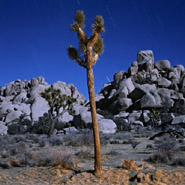
 Yucca
Brevifolia (Joshua Tree) #3
Yucca
Brevifolia (Joshua Tree) #3
© Tim Baskerville
"The cities aflood,
And our love turns to rust.
We're beaten and blown by the wind,
Trampled in dust.
I'll show you a place,
High on a desert plain
Where the streets have no name."
Where the Streets Have No Name
from Joshua Tree by U2
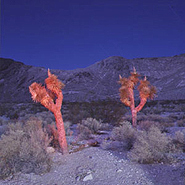
Yucca
Brevifolia (Joshua Tree) #2
© Tim Baskerville
"Cold hearted orb
that rules the night,
Removes the colours from our sight.
Red is grey and yellow white.
But we decide which is right.
And which is an illusion? . . ."
Late Lament
by Moody Blues
|
"I dream of rain.
I dream of gardens in the desert sand. I wake in
pain.
I dream of love as time runs through my hand.
"Sweet desert rose
Each of her veils, a secret promise. This desert
flower,
No sweet perfume ever tortured me more than this
sweet desert rose.
This memory of Eden haunts us all.
This desert flower, this rare perfume is the sweet
intoxication of the fall."
|
Desert Rose by Sting and
Chab Mamey
|
The Place
Joshua Tree National Park, at nearly 800,000 acres, lies at
the point where two deserts, two large ecosystems (whose characteristics
are determined primarily by elevation) meet - the Colorado
Desert, below 3,000 ft, in the eastern part of the park, and
the higher, moister, and slightly cooler Mojave Desert in
the western part of the park, and habitat of the Joshua tree,
Yucca Brevifolia. The western part of the park, where we will
be photographing at night, also includes the very surreal
geologic features that have become associated with the Joshua
Tree area. Joshua Tree became a National Monument in 1936,
remaining mostly a local or regional attraction, a well-kept
secret, but since becoming a National Park in 1994, its popularity
has rose and the numbers of visitors each year has increased.
As legend would have it, Mormon pioneers saw
the limbs of the Yucca trees and recalled the upstretched
arms of the biblical figure Joshua, leading them to the promised
land, and named them, Joshua Trees. Country-rocker Gram Parsons,
whose name has become synonymous with Joshua Tree, was similarly
inspired by this strange landscape, and traveled here often
in the 1960s. The band U2, who in 1987 immortalized the area
with their LP - simply entitled Joshua Tree
- saw similar connections between this surreal, somewhat threatening
landscape and the actual, fragile ecosystem it represents
and our own frail attempts to find solitude, love, liberty,
and freedom, realizing often times that "We still haven't
found what we're looking for."
This is the dramatic landscape we will find
ourselves visiting this May (during the Full "Flower"
Moon) - to photograph the nocturnal beauty of Joshua Tree!
We will photograph around such picturesque and iconographic
sites as Cap Rock, Split Rock, Hidden
Valley & the Live Oak areas.
Read an LA
Times article (PDF) about one of our similar Death Valley
Workshops, which appeared in the L.A. Times in October 2003.
Instructors
Lance Keimig is a Massachusetts based photographer and educator
who specializes in night photography. Lance studied Night
Photography with Steve Harper at San Francisco’s Academy of
Art University in the late ‘80s and cofounded The Nocturnes
Night Photography Workshop Serieswith Tim Baskerville in 1998.
His new book, Night Photography: Finding your way in the
Dark - a Second Edition will be published in February
2011.
Tim Baskerville, B.F.A., received his degree in photography
and liberal arts from the University of San Francisco. He
has been photographing at night for more than 25 years, and
has taught Night Photography at U.C. Berkeley Extension in
San Francisco and Berkeley, U.C. Santa Cruz. College of Marin,
Photographic Resource Center at Boston University, Boston;
RayKo Photo Center, San Francisco; and the Cape Cod Photographic
Workshops on Cape Cod. He has written articles about Night
Photography for Camera and Darkroom, the Friends of
Photography with Nazraeli Press, and Photo Metro magazine.
He originally curated The Nocturnes, a Night Photography
exhibit, in 1991, and founded the subsequent critically acclaimed
Web site - www.thenocturnes.com - in 1996.
Tuition and Schedule
Tuition $900 - Daily schedule for this three-day/night Workshop
(see the review of our Death Valley Workshop from the LA Times)
runs from 1pm to midnight - and later! This includes PowerPoint
lectures and discussions of technical considerations, before
we go out to photograph.
Participants are responsible for their own lodging
and meals - though we can make some recommendations where
to stay in Twentynine Palms, CA, at the entrance to the Park.
Camping is available within Joshua Tree National Park also,
but you need to reserve early - see links below.
Registration
Deadline to register has been extended to May 20, and more
information is included in our Registration
Form - which you will need to print out, and send or FAX
in to Pacific Media Arts.
Payment by check, Visa, Mastercard, or Paypal.
To Pay in full:
Once you secure your spot by paying with one of the Paypal
buttons above, you will be contacted with detailed information
about the workshop. Refunds, less a $50 cancellation fee to
cover time and Paypal costs are available until the payment
due in full date. You can make a deposit at any time, but
space is available on a first come basis. Payment is due in
full by April 15, 2011. You can still sign up after April
15 if there is space available, but you need to pay in full
at that time. If you need to cancel after April 15, 2011,
you will be refunded the amount you paid, less the $300 deposit.
If the workshop is cancelled for any reason, you will receive
a full refund.
Additional Information about Joshua Tree
Some inspirational links about the
Joshua Tree area
- Twentynine
Palms - The definitive Hwy 62 music video by Robert
Plant
- Big
Log - Robert continues his search for his desert muse
- Joshua
Tree - Emigre's book tribute to Gram Parsons; JT National
Park
- A
Desert Trilogy - Interview with Rudy VanderLans by
Van Dyke Parks
We hope to see you in Joshua Tree this May!
|





